
Navigating Uncertainty During Career Transition

Tundra in Autumn – 2011
Denali National Park, AK
How Experience, Adaptability and Purpose Guide Meaningful Professional Change
Meaningful transitions can place accomplished professionals in an unfamiliar position. After decades of developing expertise, solving difficult problems, and anticipating consequences, they may face a future that cannot be fully studied or predicted.
The natural response is to search for greater certainty. More information is gathered. Additional possibilities are evaluated. Decisions are reconsidered. Yet there are circumstances in which no amount of analysis can reveal the entire path ahead.
Uncertainty does not mean that preparation has failed. It means that the next phase must be discovered partly through experience. The unknown is not simply the absence of answers. It is the space in which new possibilities become visible.
Navigating that space requires curiosity, adaptability, perspective, and calm. It also requires confidence in the wisdom already acquired.
When Expertise Expects Answers
Professional success depends upon the ability to know. Physicians seek accurate diagnoses. Executives interpret complex information. Entrepreneurs calculate risks. Attorneys anticipate consequences. Leaders are expected to provide direction when others are uncertain.
These responsibilities cultivate preparedness, precision, and prediction. They also establish an understandable preference for clarity before action.
During a major professional transition, however, the future may not respond to those familiar methods. The questions become more personal. What will provide meaning? Where should experience now be directed? Which responsibilities should be retained, released, or reimagined? What form should contribution take?
These questions cannot always be resolved through analysis alone. When the desire for certainty becomes excessive, careful thought can turn into hesitation. The search for the perfect decision can prevent the smaller actions that would provide useful information.
There is a difference between thoughtful preparation and waiting for every uncertainty to disappear. The first supports movement. The second may indefinitely postpone it.
Trusting What Experience Has Created
Entering unfamiliar territory does not erase the value of prior experience. A change in circumstances does not remove the judgment, discipline, or resilience developed throughout a career.
You may not know precisely what lies ahead, but you know how to learn. You know how to evaluate circumstances, recognize patterns, recover from mistakes, and make adjustments. These capabilities remain reliable even when the environment is new.
Confidence during transition does not have to arise from knowing the outcome. It can arise from knowing yourself.
This is an important distinction. Confidence based solely on predictability weakens when conditions change. Confidence based on character and experience is more durable. It permits action without requiring guarantees.
The first step may be modest. It may involve exploring an interest, accepting a limited responsibility, initiating a conversation, or testing a new form of contribution. Such steps are not insignificant. They generate the experience from which clearer direction can emerge.
What Fear Can Reveal
Uncertainty often produces fear because familiar measurements of progress have disappeared. There may be no title, performance report, revenue target, promotion, or institutional recognition to confirm that the new direction is correct.
Rather than dismissing fear, it can be examined. Fear often identifies what a person values and what appears vulnerable. Concern about losing relevance may reveal a desire to remain useful. Anxiety about identity may demonstrate how closely the professional role became connected to the person. Reluctance to act may expose the belief that a new endeavor must immediately meet the standards of a mature career.
Seen in this way, fear becomes informative.
The response is not to permit fear to determine the future. It is to understand what fear is communicating and then act according to values rather than apprehension.
Faith in the process allows understanding to develop through participation. Clarity often follows action because action creates information that contemplation alone cannot provide.
Adaptability Without Losing Direction
Adaptability is sometimes misunderstood as surrendering control or lowering standards. In reality, it is the disciplined ability to respond to changing circumstances while preserving purpose.
An adaptable professional carries previous knowledge forward but does not insist that it must always be applied in the same manner. Leadership may become mentorship. Technical expertise may become teaching. Organizational authority may become advisory influence. Achievement may increasingly be measured by contribution rather than position.
Such changes do not diminish competence. They reveal its range.
Humility is essential because the new environment may require unfamiliar methods. Expectations may need to be revised. An attractive possibility may prove unsuitable, while an unexpected opportunity may become meaningful.
Recalibration permits the route to change without sacrificing the destination. It protects purpose from the rigidity of a single plan.
Every constructive adjustment strengthens self trust. It confirms that adaptability is not evidence of uncertainty about who you are. It is evidence that you can remain yourself while responding intelligently to change.
Discernment in the Absence of External Markers
Throughout a career, direction is often influenced by visible responsibilities and established expectations. Schedules, institutions, clients, colleagues, and professional obligations provide structure.
When that structure changes, external direction becomes quieter. This can initially feel like disorientation. It can also create the opportunity to listen more carefully.
Discernment begins with attention. Which activities create a sense of alignment? Which opportunities feel consistent with your principles? Which commitments appear impressive but lack personal meaning? Which interests have remained present but unexplored?
The answers may not arrive dramatically. They frequently appear as recurring thoughts, sustained interests, or a growing sense that one possibility deserves further examination.
Intuition should not displace reason, but neither should it be ignored. Intuition is often experience expressing itself before analysis has fully articulated the conclusion. When combined with careful thought, it can become a valuable guide.
The objective is not to seek endless external confirmation. It is to make decisions that remain consistent with integrity even when certainty is unavailable.
Seeing the Larger Pattern
Perspective helps place the current uncertainty within the broader course of life. Nearly every period of meaningful development began before its outcome was known.
Education required entering subjects not yet mastered. Professional growth required accepting responsibilities before possessing complete confidence. Leadership required decisions with incomplete information. Personal growth required confronting aspects of life that could not be controlled.
The present uncertainty belongs to that same pattern.
A wider perspective does not deny difficulty. It prevents temporary ambiguity from being interpreted as permanent disorder. It reminds you that the absence of a familiar structure may be the beginning of a new one.
Uncertainty stimulates creativity because it requires new responses. It develops empathy because it renews awareness of what others experience when familiar foundations change. It strengthens resilience because it requires continued effort without immediate reassurance.
The unknown can therefore become formative. It tests existing strengths and calls new ones into expression.
The Leadership of Remaining Calm
Calm during transition is not indifference. It is disciplined steadiness.
A calm person does not deny uncertainty. He or she recognizes it without allowing it to dominate judgment. Calm preserves the ability to think clearly, observe accurately, and respond deliberately.
It also communicates confidence to family members, colleagues, and others affected by the transition. People often take their emotional cues from those they trust. A composed presence assures them that uncertainty can be managed even when it cannot yet be resolved.
This is leadership expressed without title or authority.
The unknown cannot be mastered in the same way as a technical subject. It must be navigated. The professional who moves forward with curiosity, discernment, adaptability, and calm does not require a complete map.
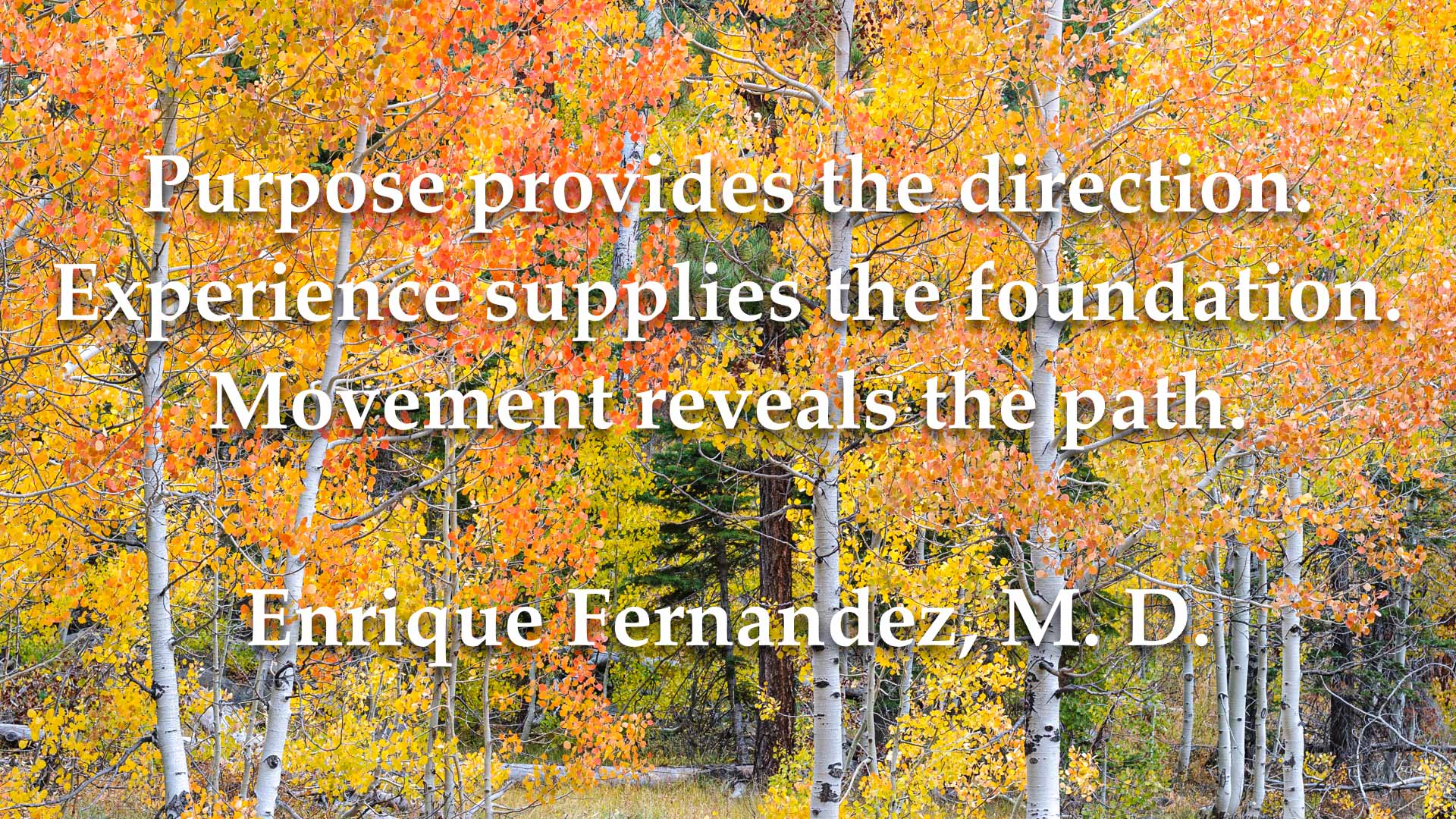
Purpose provides the direction. Experience supplies the foundation. Movement reveals the path.
Updated: September 25, 2026
PS: Would you like to learn more about how to transition successfully from your career? I provide services to physicians, non-medical credentialed professionals, corporate executives, businessmen and entrepreneurs that are tailored to their specific needs. Click here to request an introductory conversation.
If you would like to learn about another way that I can guide you, check out this brief video that describes my unique online course:
The Practice Transition Course for Physicians. TM
The Path and its Beauty – 2019
Sierra Nevada, NV
ACCESS FREE GUIDE:
How to Transition Successfully from Your Career -
The Core Concerns
